The Best Pizza in Austin: A Neapolitan Guide (2026)
Neapolitan, New York, Detroit, Texas bar pie — Austin has all of it. Here's how to tell great pizza from merely good, and what to look for before you order.
Ask ten people in this city where to find the best pizza in Austin and you will get ten confident, completely different answers — and, remarkably, most of them will be defensible. Austin is not a one-style pizza town. On a single afternoon you can eat a foldable New York slice, a thick-edged Detroit square, a griddled Texas bar pie, and a blistered Neapolitan pie pulled from a live fire in ninety seconds. Those are not better and worse versions of the same food. They are four different crafts that happen to share a name.
That is why "best" is a bad question on its own and a great question once you narrow it. What follows is a guide to narrowing it: how the major styles differ, what actually separates a great pizza from a merely competent one, and what to look for on the plate before you decide whether a place is worth the trip. We make Neapolitan pizza on West 6th Street, so we have an obvious bias — but the criteria below hold no matter whose oven you're standing in front of.
First, decide which pizza you actually want
Style is the fork in the road. New York style is a large, thin, gas-oven pie built to be reheated and folded; its virtue is structure and portability, and a good one has a crackle at the tip that gives way to chew. Detroit and Sicilian styles are pan-baked, thick, and defined by the caramelized cheese edge that forms where dairy meets hot steel. Texas bar pies — cracker-thin, cut in a tavern grid — are built for a bar top and a cold beer, and they are unapologetically crisp all the way through.
Neapolitan is the outlier. It is the oldest of the disciplines and the most constrained: a small pie, a very wet dough, a screaming-hot live fire, and a bake measured in seconds rather than minutes. It produces a puffed, spotted rim and a soft, almost custardy center. If you arrive at a Neapolitan restaurant expecting a rigid New York slice, you will be disappointed by a pizza that is doing exactly what it is supposed to do. Choose the style first, then judge the execution.
The dough tells you everything
Almost every meaningful difference between a great pizza and a forgettable one is decided long before the pie goes near an oven. Dough is flour, water, salt and yeast — four ingredients, which means there is nowhere to hide. What separates them is time.
A dough mixed in the morning and baked at dinner will taste like bread that hasn't finished thinking. A dough given a long, slow ferment develops flavor compounds that simply cannot be shortcut, and it becomes far more digestible in the process — one reason people who feel leaden after most pizza often don't after a properly fermented one. Ours ferments for 48 hours before it ever sees the fire. When you're evaluating a new pizzeria, asking how long the dough rests is the single most informative question you can ask.
- Flour: finely milled Italian flour — we use Caputo Type "0" — is engineered for high-heat, fast bakes and gives the rim its characteristic tenderness.
- Time: a long ferment builds flavor and digestibility. Hours matter more than any ingredient upgrade.
- Hydration: wetter doughs puff dramatically in a hot oven. They are harder to handle, which is why they're a good signal of a confident kitchen.
Fire is not a garnish
"Wood-fired" has become a menu decoration in a lot of places, which is a shame, because a live fire genuinely changes the food. Radiant heat from a domed oven cooks the top of the pie while the deck cooks the bottom, and the whole thing finishes before the moisture in the dough has time to escape. That is the entire trick: enough heat, fast enough, that the crust sets while the interior stays soft.
Our oven runs at 700 degrees and turns out a pie in a couple of minutes. A conveyor oven at a fraction of that temperature will take fifteen, and the result is a fundamentally different bread — drier, more uniform, less alive. Neither is wrong. But if a menu advertises Neapolitan and the pizza takes twenty minutes to arrive from a metal box, the words and the machine are not in agreement.
What to look for when it hits the table
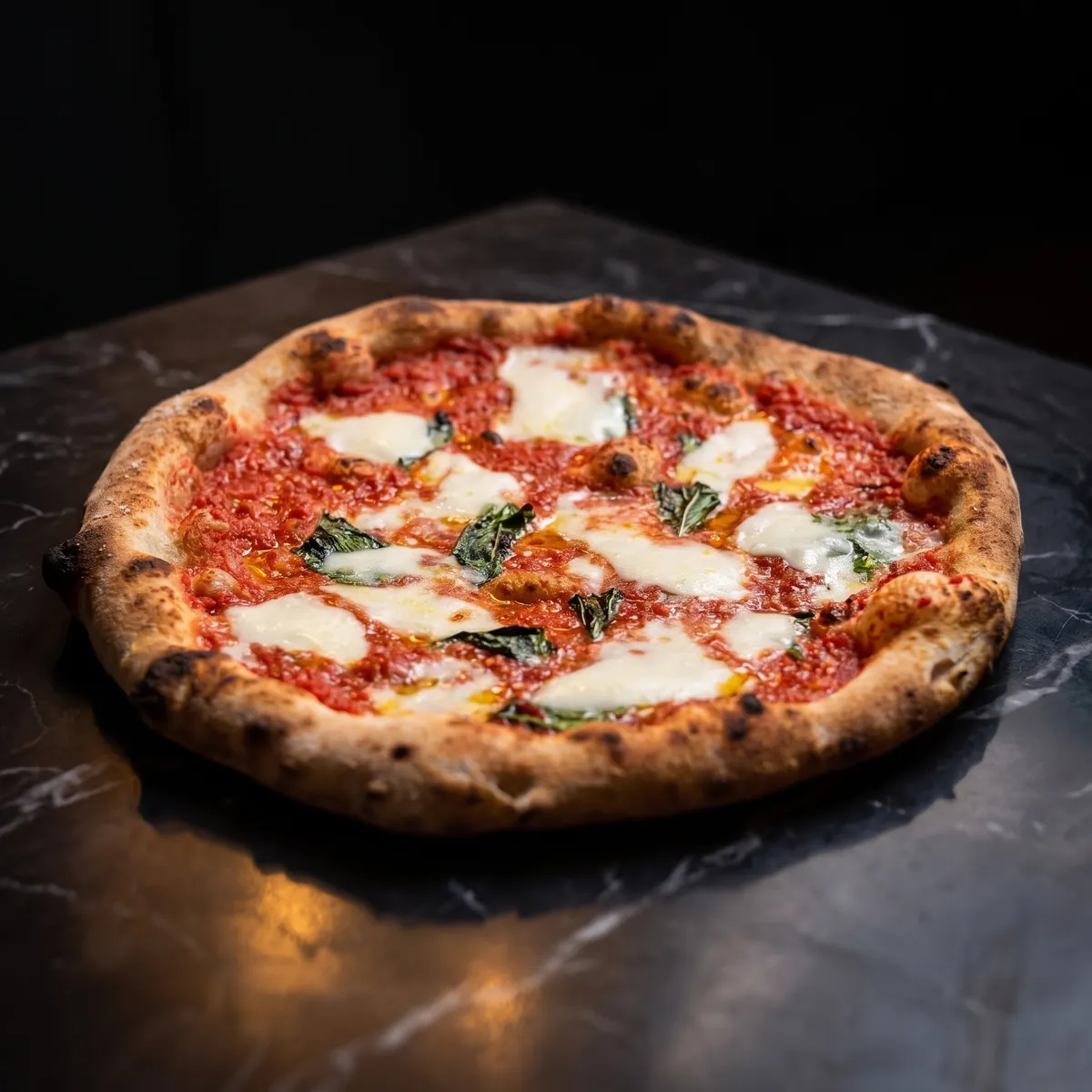
You can assess a Neapolitan pie in about four seconds, before you take a bite. Look at the rim — the cornicione. It should be puffed and irregular, with dark blisters scattered across it. Those spots are called leopard-spotting, and they're the visible proof that the pie met serious heat quickly. A uniformly tan, evenly browned rim means a slower, cooler bake.
Then look at the middle. It should be moist and slightly yielding, with the sauce and cheese still distinct rather than merged into a single molten field. A small amount of liquid in the center is normal and correct for the style. Finally, pick up a slice by the rim: a good Neapolitan pie will bend, and the tip may droop. That's not a flaw. A pie that stays rigid has lost more water than the style intends.
Toppings: restraint is the tell
The most reliable signal of a serious pizza kitchen is a short pizza list. Neapolitan tradition is built on very few components treated very well — San Marzano-style tomatoes that need nothing but salt, fresh mozzarella, good oil, basil. A menu with forty combinations is usually telling you that the dough is not the point.
That doesn't mean a Neapolitan kitchen has to be a museum. Our own menu runs from a straightforward Margherita to pies built around foraged mushroom and truffle, and there is nothing traditional about a pizzeria that also runs a full Italian–Texan cocktail program. The discipline is in the technique, not in refusing to have ideas. You can see the whole list on our pizza menu.
Where Moderna fits on the map
We're on West 6th Street, at the Mopac end of downtown, and we make Post-Heritage Neapolitan pizza: Naples technique, executed here, alongside scratch pasta and a bar that treats Italian aperitivo culture and Texas drinking culture as compatible. The kitchen is run by Maestro Leo Spizzirri, and the restaurant was recognized by readers as Best New Restaurant in Austin.
The practical case for us on a weeknight is the location: free validated parking in the attached garage, which is not a small thing downtown, and a room that works equally well for a bar seat alone or a table of six. Details on hours, parking and how to find us are on the visit page, and you can book directly through our reservations page.
How to build your own shortlist
If you want to run this exercise properly across Austin, do it by style rather than by ranking. Pick a Neapolitan place, a New York place, and a pan place, and eat a plain pie at each — Margherita or cheese, nothing else. Toppings hide problems; a plain pie doesn't. Judge the rim, the underside, the salt level and how you feel an hour later.
Do that three times and you'll stop asking who makes the best pizza in Austin and start knowing which pizza you're in the mood for — which is a far more useful thing to know on a Friday night. And when the answer is blistered, soft-centered and out of a live fire, we are ten minutes from most of downtown.
Frequently asked
What style of pizza is Moderna?
Neapolitan — dough made in-house, a live wood fire, and a very short bake. We call ours Post-Heritage Neapolitan: Neapolitan technique, cooked in Austin, with a menu that isn't afraid of local ingredients.
Is Neapolitan pizza supposed to be soft in the middle?
Yes. A correctly baked Neapolitan pie has a puffed, airy rim and a tender center. It is not a cracker crust, and the middle is meant to be eaten with a knife and fork or folded — that softness is the style working as intended, not underbaking.
Where is the best pizza in downtown Austin?
Downtown has several strong options across different styles. If you want Neapolitan specifically, look for a restaurant with a live-fire oven and dough fermented over a day or more. Ours is on West 6th Street with free validated parking in the attached garage.
West 6th Street Restaurants
The West 6th corridor is downtown Austin's most walkable stretch of dining. Here's how the block actually works, and how to plan a night on it.
What Is Neapolitan Pizza?
Four ingredients, one fire, ninety seconds. A guide to the oldest pizza discipline in the world — and how to judge it when it lands on your table.